🖼
Fig. 1: Proposed C9ORF72 disease mechanisms. The C9ORF72 (GGGGCC) hexanucleotide repea...
active
paper figure
Created: 2026-04-12T04:58:30
By: paper_figures_pipeline
Quality:
95%
🔗 External
ID: paper-fig-37847372-1
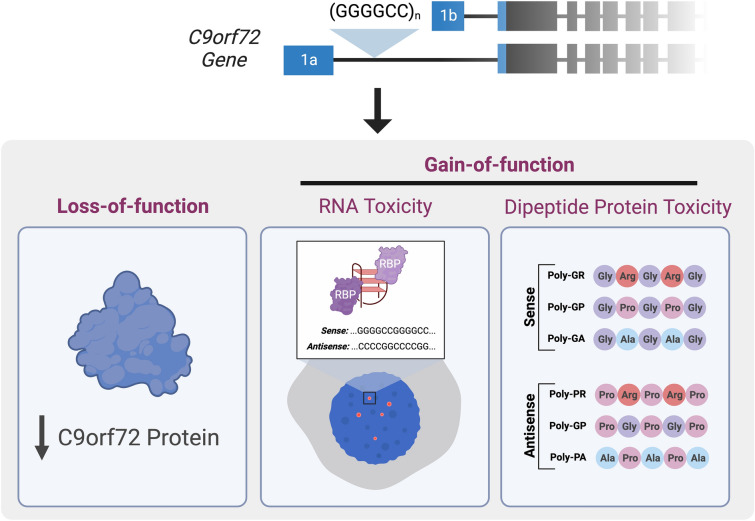
Fig. 1Figure 1
Proposed C9ORF72 disease mechanisms. The C9ORF72 (GGGGCC) hexanucleotide repeat expansion is thought to contribute to disease pathogenesis in frontotemporal dementia (FTD) and amyotrophic lateral sclerosis (ALS) via three non-mutually exclusive mechanisms: (1) a loss of function due to impaired transcription leading to a reduction in C9ORF72 protein levels; (2) a toxic gain of function due to the formation of secondary RNA structures which sequester RNA binding proteins and consequently a loss of function of these proteins; (3) a toxic gain of function due to repeat-associated non-ATG (RAN) translation from both the sense and antisense strand, which generates potentially toxic dipeptide repeats (DPRs; poly-GP, poly-GA, poly-GR, poly-PA, poly-PR)
▸Metadata
| doi | |
| pmcid | PMC10630271 |
| _origin | {'url': 'https://www.ebi.ac.uk/europepmc/articles/PMC10630271/bin/40120_2023_548_Fig1_HTML.jpg', 'type': 'external', 'tracked_at': '2026-04-12T11:58:30.391184'} |
| caption | Proposed C9ORF72 disease mechanisms. The C9ORF72 (GGGGCC) hexanucleotide repeat expansion is thought to contribute to disease pathogenesis in frontotemporal dementia (FTD) and amyotrophic lateral sc |
| paper_id | 37847372 |
| image_url | https://www.ebi.ac.uk/europepmc/articles/PMC10630271/bin/40120_2023_548_Fig1_HTML.jpg |
| image_path | |
| description | |
| figure_label | Fig. 1 |
| figure_number | 1 |
| _schema_version | 1 |
| source_strategy | pmc_api |
| entities_mentioned |
📊 Evidence Profile
Evidence Balance
+0%
Certainty
0%
Debates
0
Incoming
0
Outgoing
1
0 supporting
0 contradicting
0 neutral
Public annotations (0)Annotate on Hypothes.is →
No public annotations yet.