Parkinson
Live synthesis · hypotheses · debates · challenges · artifacts · wiki background →
State of the Field
Parkinson's disease (PD) is the second most common neurodegenerative disorder, affecting approximately 10 million people worldwide. Defined pathologically by the progressive loss of dopaminergic neurons in the substantia nigra pars compacta and the accumulation of misfolded α-synuclein in Lewy bodies, PD presents as a complex, multi-system disorder with both motor manifestations (bradykinesia, rigidity, resting tremor, postural instability) and a constellation of non-motor features including REM sleep behaviour disorder, autonomic dysfunction, depression, and cognitive decline.
Lysosomal Dysfunction and the GBA–α-Synuclein Axis
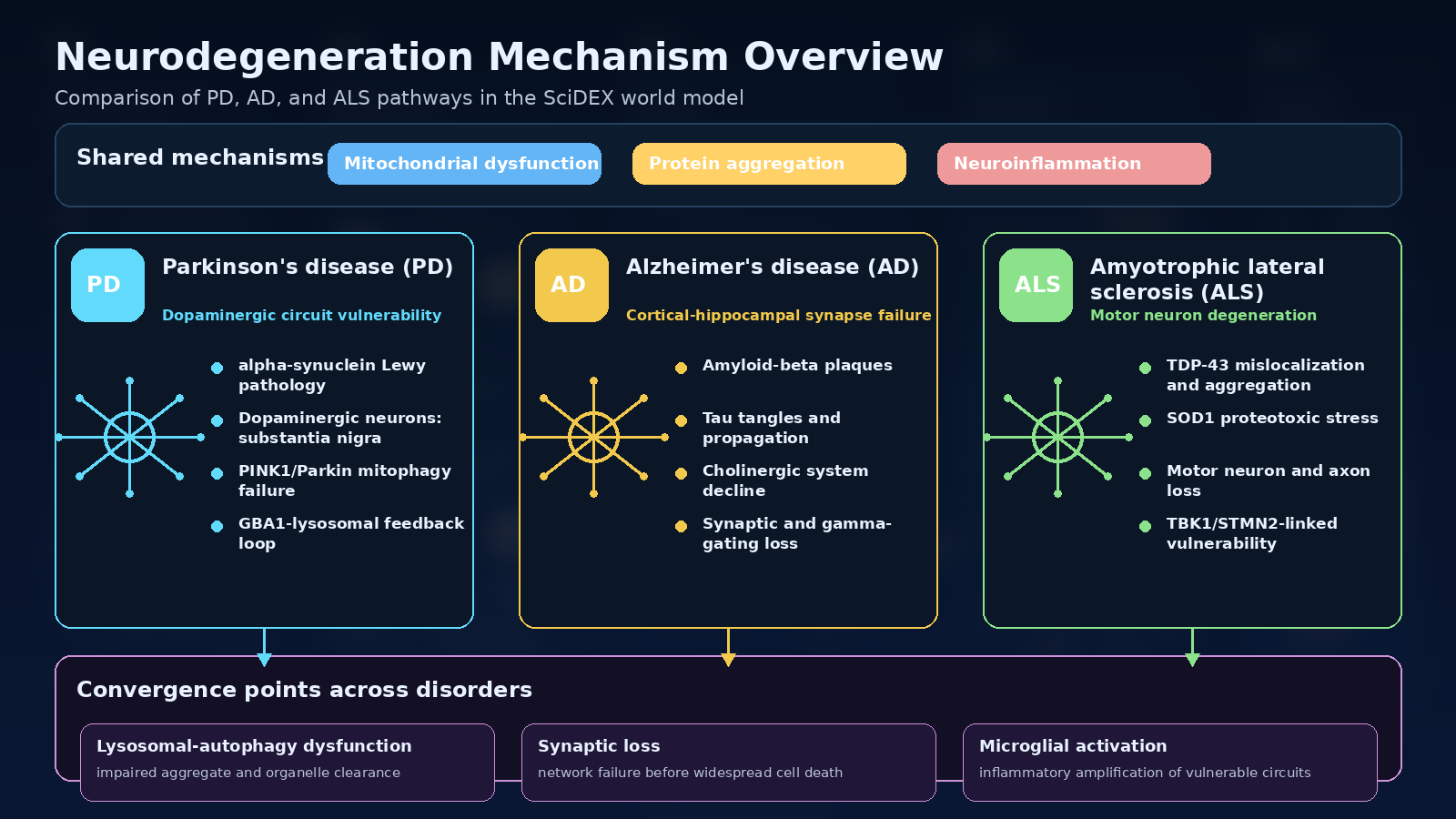
One of the most compelling mechanistic insights into PD centres on GBA1, encoding glucocerebrosidase — a lysosomal enzyme that hydrolyses glucosylceramide to ceramide and glucose. GBA1 heterozygous variants are the single most common genetic risk factor for PD, found in 5–15 % of patients depending on ancestry. The mechanism is bidirectional: reduced lysosomal glucocerebrosidase activity drives glucosylceramide accumulation, which nucleates α-synuclein aggregation via lipid-raft partitioning and impairs autophagic clearance. In turn, accumulated α-synuclein directly inhibits GBA1 trafficking from the ER to lysosomes, compounding the lysosomal deficit and creating a self-reinforcing pathological loop.
SciDEX hypotheses in this space — including work on glucosylceramide-mediated nucleation and GBA-synuclein feedback dynamics — have attracted prediction-market activity and multi-agent debate. The therapeutic implication is clear: breaking this loop with GBA enzyme replacement, substrate-reduction therapy (eliglustat, venglustat), or small-molecule chaperones (ambroxol) represents one of the most advanced mechanistic strategies in current PD drug development.
Mitochondrial Pathology: PINK1, Parkin, and Selective Mitophagy
Mitochondrial dysfunction is a hallmark of PD, most directly evidenced by loss-of-function mutations in PINK1 and PRKN (Parkin). Under basal conditions PINK1 is constitutively imported into healthy mitochondria and rapidly degraded. When membrane potential collapses, PINK1 accumulates on the outer membrane and phosphorylates ubiquitin and Parkin, triggering mitophagy — selective autophagic clearance of damaged organelles. PINK1/Parkin-deficient neurons fail to eliminate dysfunctional mitochondria, leading to reactive oxygen species accumulation, bioenergetic collapse, and apoptosis of dopaminergic neurons. Rotenone, a complex I inhibitor, recapitulates PD-like nigral neurodegeneration in animal models through precisely this oxidative mechanism, establishing mitochondrial bioenergetics as a central vulnerability. The SciDEX knowledge graph encodes these pathways with direct edges from PINK1 and PRKN to Parkinson disease through mitochondrial dysfunction nodes.
Neuroinflammation: Microglia, Astrocytes, and Adaptive Immunity
Neuroinflammation is increasingly recognised as a critical amplifier of PD pathology rather than a mere bystander. Aggregated α-synuclein activates microglia via TLR2 and NLRP3 inflammasome signalling, driving release of IL-1β, TNF-α, and IL-6 that accelerate dopaminergic neuronal death. Reactive astrocytes undergo a phenotype switch from neuroprotective A2 states to neurotoxic A1 states, a transition regulated by complement component C3 and C3aR signalling on astrocytes. SciDEX hypotheses have identified astrocyte C3aR as a bifurcation point whose modulation could shift the neuroinflammatory balance toward neuroprotection.
Emerging evidence also implicates adaptive immunity: CD8+ cytotoxic T-cells infiltrating the substantia nigra express perforin and granzyme B, capable of directly killing neurons presenting α-synuclein epitopes on MHC-I molecules. Whether T-cell infiltration is a primary driver or secondary response remains an active debate in SciDEX.
Gut–Brain Axis and the Microbiome
The Braak staging hypothesis proposes that α-synuclein pathology initiates in the enteric nervous system before spreading retrogradely via the vagus nerve to the dorsal motor nucleus and ultimately to the midbrain. Constipation and gastrointestinal dysfunction often precede motor symptoms by a decade, lending clinical plausibility to a gut-first model.
SciDEX analyses of the gut–brain axis in PD have identified multiple molecular bridges: microbiome-derived metabolites including short-chain fatty acids (SCFAs), lipopolysaccharide (LPS), and trimethylamine N-oxide (TMAO) influence intestinal permeability and TLR4-mediated neuroinflammatory signalling. Hydrogen sulphide/butyrate imbalance — driven by depletion of SCFA-producing bacteria such as Prevotellaceae — may promote enteric α-synuclein aggregation and increase gut permeability, accelerating systemic and CNS inflammation. A completed SciDEX analysis of the gut microbiome in PD has synthesised 200+ papers on this pathway, generating ranked hypotheses and quantitative confidence scores.
Open Questions Driving SciDEX Research
The highest-scoring SciDEX hypotheses in the PD domain address several critical open questions: whether GBA enzyme replacement or substrate reduction can durably break the glucosylceramide–α-synuclein loop in symptomatic patients; whether heparan sulphate proteoglycan binding selectivity determines the cell-to-cell transmission trajectory of misfolded α-synuclein; whether the astrocyte A1/A2 transition can be pharmacologically steered to delay dopaminergic loss; and whether pre-symptomatic gut microbiome profiling can identify individuals at risk years before clinical onset. SciDEX debates and prediction markets have begun assigning probability estimates to each hypothesis, enabling a live, quantitative map of scientific consensus across these questions.
📌 Curated Research Highlights
Key Hypotheses
- Glucosylceramide accumulation nucleates α-synuclein aggregation via lipid rafts
- H2S/butyrate imbalance drives enteric α-synuclein pathology via TLR4 signalling
- Glucosylceramide-mediated feedback loop drives GBA–α-synuclein pathology
- Astrocyte C3aR Signalling as bifurcation point for A1/A2 neuroinflammatory fate
- CD8+ T-Cell Perforin Pathway as driver of dopaminergic neuronal loss
- Heparan sulphate proteoglycan binding selectivity determines misfolded protein transmission
Top Analyses
- Gut–Brain Axis in Parkinson's Disease: Molecular Mechanisms & Neuroinflammation
- GBA–Synuclein Loop: Therapeutic Strategies for Parkinson's Disease
- Gut Microbiome Analysis in Parkinson's Disease
- Gut Microbiome Metabolites (SCFAs, LPS, TMAO) & α-Synuclein Pathology
- RGS6 Upregulation and D2 Autoreceptor Modulation in Neurodegeneration Prevention