Cell type vulnerability in Alzheimers Disease (SEA-AD transcriptomic data)
Research Question
“What cell types are most vulnerable in Alzheimers Disease based on SEA-AD transcriptomic data from the Allen Brain Cell Atlas? Identify mechanisms of cell-type-specific vulnerability in neurons, microglia, astrocytes, and oligodendrocytes. Focus on gene expression patterns, pathway dysregulation, and therapeutic implications.”
ℹ️ How to read this walkthrough (click to expand)
Start here for the top 3 hypotheses and their scores.
Four AI personas debated the question. Click “Read full response” to expand.
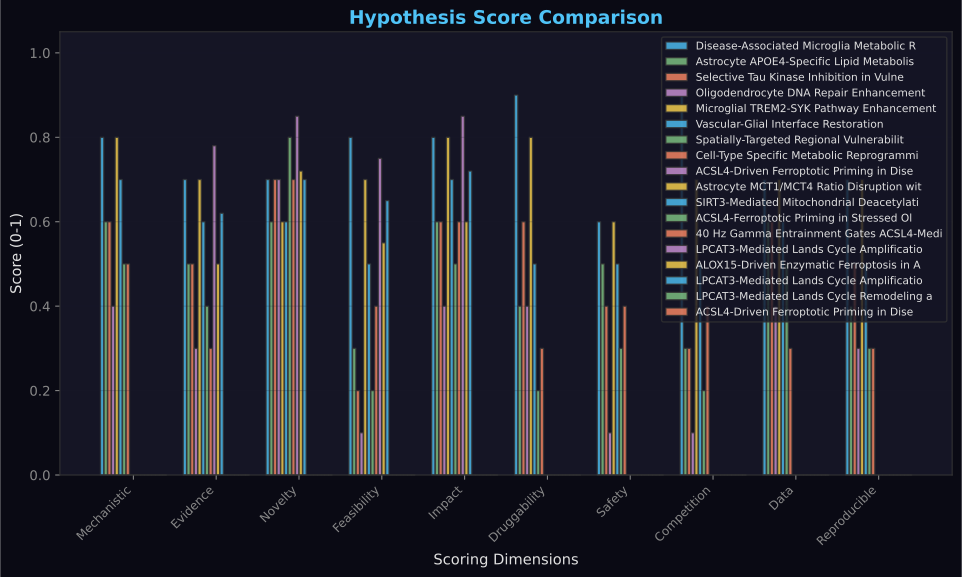
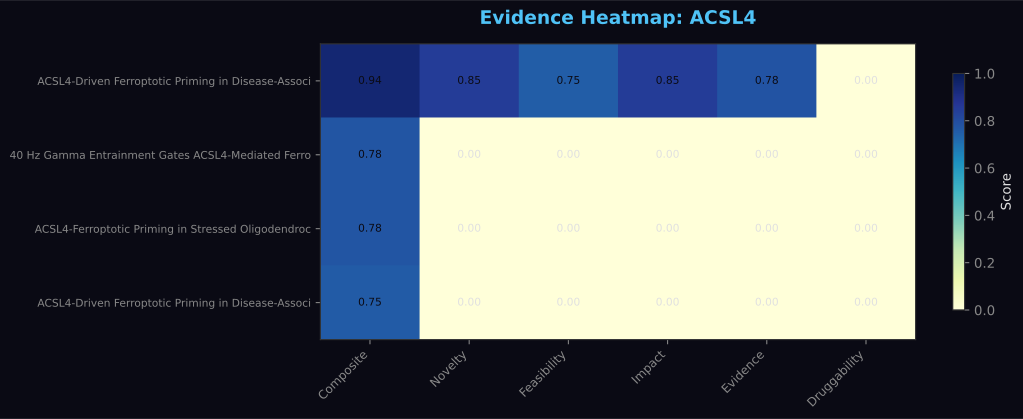
Each hypothesis is scored on 8+ dimensions from novelty to druggability.
Interactive network of molecular relationships. Drag nodes, scroll to zoom.
Analysis Journey
Key Findings
## Mechanistic Overview Cell-Type Specific Metabolic Reprogramming starts from the claim that modulating PPARA within the disease context of neurodegeneration can redirect a disease-relevant process.
Score: 0.64## Mechanistic Overview Astrocyte MCT1/MCT4 Ratio Disruption with Metabolic Uncoupling starts from the claim that modulating SLC16A1 within the disease context of Alzheimer's Disease can redirect a di
Score: 0.67## Mechanistic Overview SIRT3-Mediated Mitochondrial Deacetylation Failure with PINK1/Parkin Mitophagy Dysfunction starts from the claim that modulating SIRT3 within the disease context of Alzheimer's
Score: 0.74How This Analysis Was Created
An AI agent scanned recent literature to identify under-explored research questions at the frontier of neuroscience.
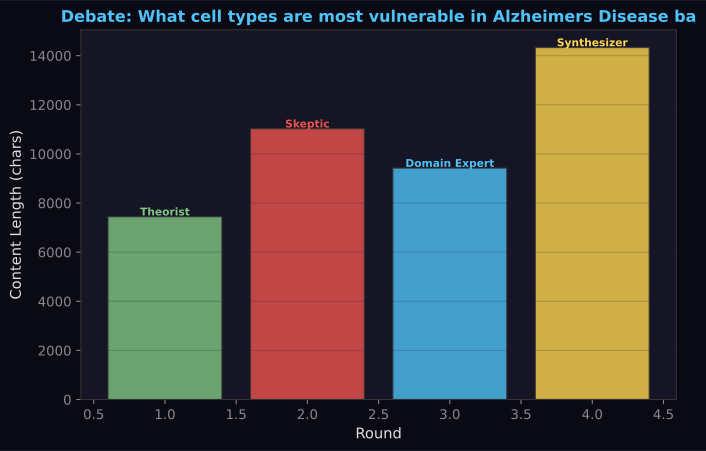
Four AI personas (Theorist, Skeptic, Domain Expert, Synthesizer) debated the question across 4 rounds, generating and stress-testing hypotheses.
Each hypothesis was evaluated against PubMed literature, clinical trial data, and gene expression databases to build an evidence portfolio.
281 molecular relationships were extracted and mapped into an interactive knowledge graph connecting genes, pathways, and diseases.
Executive Summary
The comprehensive evaluation reveals that while cell-type specific approaches represent an intellectually compelling direction for Alzheimer's therapeutics, significant gaps exist between theoretical promise and practical implementation. The TREM2-SYK pathway enhancement emerges as the most viable hypothesis with a composite score of 0.71, benefiting from strong mechanistic rationale, active industry investment, and existing clinical programs. This approach leverages established genetic validation through TREM2 variants and has clear druggability through both small molecules and biologics, though concerns remain about potential inflammatory consequences and the optimal therapeutic window.
The remaining hypotheses face substantial barriers ranging from technical impossibility of cell-type specific targeting to fundamental safety concerns with DNA repair modulation. The tau kinase inhibition approach, despite strong transcriptomic evidence, suffers from a poor clinical track record and the challenge of achieving neuronal subtype selectivity. Similarly, the spatially-targeted and oligodendrocyte DNA repair approaches represent promising scientific concepts that lack the necessary technological infrastructure for implementation. The synthesis indicates that while single-cell transcriptomics provides valuable insights into disease mechanisms, the translation to therapeutics requires significant advances in drug delivery, target selectivity, and our understanding of causal versus
Multi-Agent Debate
Four AI personas — Theorist, Skeptic, Domain Expert, and Synthesizer — debated this research question across 4 rounds of rigorous scientific discourse.
Based on my research into cell type vulnerability in Alzheimer's Disease using transcriptomic data, I'll generate novel therapeutic hypotheses targeting the most vulnerable cell populations. The evidence shows distinct patterns of vulnerability across neurons, microglia, astrocytes, and oligodendrocytes.
Novel Therapeutic Hypotheses for Cell-Type Specific Alzheimer's Disease Interventions
...
{"hypothesis_title":"Microglial TREM2-SYK Pathway Enhancement","synthesis_summary":"The TREM2-SYK pathway represents a genetically-supported mechanism for microglial homeostasis with emerging Phase 2 clinical validation via AL002. Strong human genetic evidence (R47H/R62H variants, ~3-fold AD risk) provides disease relevance, though significant species translation gaps exist between murine microg
...Hypotheses (19)
Score Comparison
Gene Expression Context
Expression data from Allen Institute and other transcriptomic datasets relevant to the target genes in this analysis.
Gene Expression Context (SEA-AD)
SLC16A1 (MCT1): 1.9±0.4 fold downregulated in reactive astrocyte clusters (Astro-1, Astro-2). Most pronounced in GFAP-high subpopulations near amyloid plaques. Decline begins at Braak II-III, preceding neuronal metabolic gene changes.
SLC16A3 (MCT4): 2.3±0.5 fold upregulated in reactive astrocytes. Normally expressed at low levels, MCT4 becomes the dominant monocarboxylate transporter in disease-associated astrocytes. MCT1/MCT4 ratio inverts from ~3
Gene Expression Context (SEA-AD)
SIRT3: 2.1±0.4 fold downregulated in vulnerable excitatory neuron clusters (Exc-L2/3-IT, Exc-L2/3-RORB) at Braak III-VI. Shows biphasic pattern: modest upregulation at Braak I-II (compensatory), then progressive decline. Expression maintained in inhibitory neurons and glia.
PINK1: 1.7±0.3 fold downregulated in EC excitatory neurons beginning at Braak II — precedes SIRT3 decline by ~1 Braak stage. Suggests mitophagy failure is the initiating event.
Hypothesis Pathway Diagrams (19)
Molecular pathway diagrams generated for each hypothesis, showing key targets, interactions, and therapeutic mechanisms.
flowchart TD
    A["Lipid Metabolism Dysregulation"] --> B["PPARA Pathway Imbalance"]
    B --> C["Membrane Composition Change"]
    C --> D["Lipid Raft Disruption"]
    D --> E["Receptor Signaling Impairment"]
    E --> F["Neuronal Dysfunction"]
    G["Lipid Homeostasis Restoration"] --> H["Membrane Remodeling"]
    H --> I["Signaling Recovery"]
    I --> J["Neuronal Health"]
    style A fill:#b71c1c,stroke:#ef9a9a,color:#ef9a9a
    style G fill:#1a237e,stroke:#4fc3f7,color:#4fc3f7
    style J fill:#1b5e20,stroke:#81c784,color:#81c784
graph TD
    A["Neuroinflammation
IL-1beta, TNF-alpha, C3"] --> B["Astrocyte Reactivity
JAK-STAT3 Activation"]
    B --> C["GFAP Upregulation
Reactive Phenotype"]

    C --> D["SLC16A1/MCT1
Downregulation -1.9x"]
    C --> E["SLC16A3/MCT4
Upregulation +2.3x"]
    C --> F["Warburg-like Shift
HK2up PKM2up LDHAup"]

    D --> G["Loss of Demand-Matched
Lactate Export"]
    E --> H["High-Threshold
Pulsatile Release"]
    F --> I["Intracellular Lactate
Accumulation"]

    G --> J["Metabolic Uncoupling
from Neuronal Demand"]
    H --> J
    I --> H

    J --> K["Neuronal Energy
Deficit During LTP"]
    K --> L["Synaptic Dysfunction
fEPSPdown 30-40%"]
    L --> M["Memory Impairment
Encoding Failure"]
    M --> N["Cognitive Decline"]

    O["Amyloid-beta Plaques"] --> A
    P["Complement Activation
C1q, C3"] --> A

    style J fill:#ff6b6b,stroke:#c92a2a,color:#fff
    style N fill:#ff8787,stroke:#c92a2a,color:#fff
    style D fill:#ffd43b,stroke:#f08c00,color:#000
    style E fill:#ffd43b,stroke:#f08c00,color:#000
    style B fill:#748ffc,stroke:#364fc7,color:#fff
graph TD
    A["PGC-1alpha Downregulation
Master Regulator Loss"] --> B["SIRT3 Transcriptiondown"]
    A --> C["TFAM/NRF1down
Mitochondrial Biogenesisdown"]

    B --> D["NAD+-dependent
Deacetylase Loss"]
    D --> E["Complex I/II
Hyperacetylation"]
    D --> F["SOD2 Hyperacetylation
K68/K122"]
    D --> G["IDH2 Hyperacetylation"]

    E --> H["Electron Transfer
Efficiency -35-45%"]
    F --> I["Antioxidant
Capacity -60-80%"]
    G --> J["NADPH Productiondown"]

    H --> K["Excess ROS
Generation"]
    I --> K
    J --> K

    L["PINK1 Downregulation
Precedes SIRT3 Loss"] --> M["Failed Mitophagy
Signaling"]
    M --> N["Damaged Mitochondria
Accumulate"]
    K --> N

    N --> O["ROS-Generating
'Toxic Factories'"]
    O --> P["Oxidative DNA Damage
Protein Aggregation"]
    P --> Q["Tau Hyperphosphorylation
p-tau181, p-tau231"]
    Q --> R["Neurofibrillary
Tangle Formation"]
    R --> S["EC Layer II/III
Neuron Loss"]

    style O fill:#ff6b6b,stroke:#c92a2a,color:#fff
    style S fill:#ff8787,stroke:#c92a2a,color:#fff
    style D fill:#ffd43b,stroke:#f08c00,color:#000
    style M fill:#ffd43b,stroke:#f08c00,color:#000
    style A fill:#748ffc,stroke:#364fc7,color:#fff
flowchart TD
    A["Complement Activation"] --> B["C1q/C3b Opsonization"]
    B --> C["Synaptic Tagging"]
    C --> D["Microglial Phagocytosis"]
    D --> E["Synapse Loss"]
    F["TREM2 Modulation"] --> G["Complement Cascade Block"]
    G --> H["Reduced Synaptic Tagging"]
    H --> I["Synapse Preservation"]
    I --> J["Cognitive Protection"]
    style A fill:#b71c1c,stroke:#ef9a9a,color:#ef9a9a
    style F fill:#1a237e,stroke:#4fc3f7,color:#4fc3f7
    style J fill:#1b5e20,stroke:#81c784,color:#81c784
graph TD
    A["Amyloid-beta plaques
and inflammatory signals"] --> B["Microglial activation
to DAM phenotype"]
    B --> C["ACSL4 gene
transcriptional upregulation"]
    C --> D["ACSL4 protein
enzymatic activity increase"]
    D --> E["Arachidonic acid esterification
to arachidonyl-CoA"]
    D --> F["Adrenic acid esterification
to adrenoyl-CoA"]
    E --> G["PE-AA synthesis
in membrane phospholipids"]
    F --> H["PE-AdA synthesis
in membrane phospholipids"]
    G --> I["PUFA-PE membrane
substrate accumulation"]
    H --> I
    B --> J["GPX4 downregulation
and GSH depletion"]
    I --> K["Ferroptotic priming
state establishment"]
    J --> K
    L["Iron accumulation
in brain tissue"] --> M["Fenton reaction
hydroxyl radical generation"]
    M --> N["Lipid peroxidation
of PUFA-PE substrates"]
    K --> N
    N --> O["Membrane integrity
disruption and damage"]
    O --> P["Microglial ferroptotic
cell death execution"]
    P --> Q["Pro-inflammatory
mediator release"]
    P --> R["Reduced phagocytic
clearance capacity"]
    Q --> S["Neuroinflammation
amplification"]
    R --> T["Amyloid plaque
accumulation"]
    S --> U["Neuronal dysfunction
and cognitive decline"]
    T --> U

    classDef normal fill:#4fc3f7,stroke:#2196f3
    classDef therapeutic fill:#81c784,stroke:#4caf50
    classDef pathology fill:#ef5350,stroke:#f44336
    classDef outcome fill:#ffd54f,stroke:#ff9800
    classDef molecular fill:#ce93d8,stroke:#9c27b0

    class A,L pathology
    class B,C,D,E,F,G,H,I,J,M,N normal
    class K,O,P molecular
    class Q,R,S,T outcome
    class U pathology
Clinical Trials (39)
Active and completed clinical trials related to the hypotheses in this analysis, sourced from ClinicalTrials.gov.
Target Proteins & Genes (12)
Key molecular targets identified across all hypotheses. Click any gene to open its entity page; structural PDB references are linked when available.
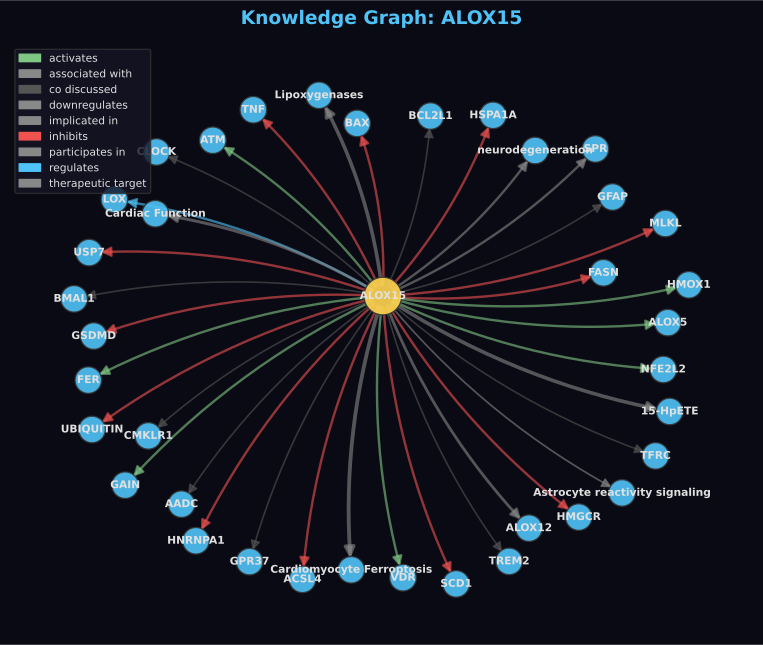
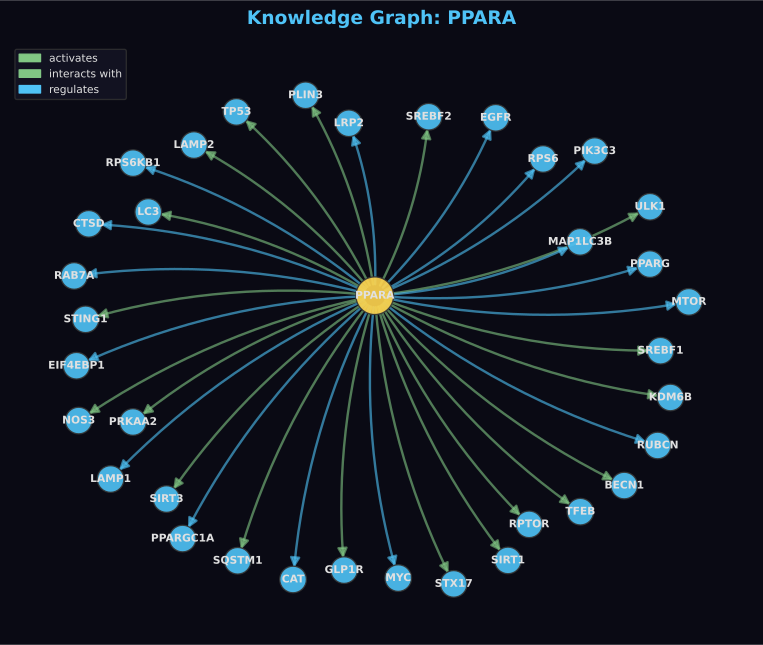
Knowledge Graph (281 edges)
Interactive visualization of molecular relationships discovered in this analysis. Drag nodes to rearrange, scroll to zoom, click entities to explore.
activates (10)
amplifies (1)
associated with (29)
▸ Show 24 more
causal extracted (7)
causes (21)
▸ Show 16 more
co discussed (167)
▸ Show 162 more
drives (1)
dysregulates (1)
enhances (1)
implicated in (6)
▸ Show 1 more
inhibits (3)
investigated in (1)
maintains (1)
participates in (3)
performs (1)
regulates (15)
▸ Show 10 more
risk factor for (3)
targets (1)
therapeutic target for (1)
vulnerable to (1)
Pathway Diagram
Key molecular relationships — gene/protein nodes color-coded by type
graph TD
    LPCAT3["LPCAT3"] -->|causes| ferroptotic_vulnerability["ferroptotic vulnerability"]
    LPCAT3_1["LPCAT3"] -->|regulates| arachidonoyl_CoA["arachidonoyl-CoA"]
    LPCAT3_2["LPCAT3"] -->|regulates| Lands_cycle_remodeling["Lands cycle remodeling"]
    LPCAT3_3["LPCAT3"] -->|causes| PUFA_PE["PUFA-PE"]
    ACSL4["ACSL4"] -->|regulates| ferroptosis_sensitivity["ferroptosis sensitivity"]
    ACSL4_4["ACSL4"] -->|regulates| Ferroptosis_Sensitivity["Ferroptosis Sensitivity"]
    ACSL4_5["ACSL4"] -->|causes| LIPID_PEROXIDATION["LIPID_PEROXIDATION"]
    Iron_Accumulation["Iron Accumulation"] -->|causes| oxidative_stress["oxidative_stress"]
    neuron["neuron"] -->|implicated in| Alzheimer_s_disease["Alzheimer's disease"]
    Trem2_Signaling["Trem2 Signaling"] -->|regulates| Microglial_Phagocytosis["Microglial Phagocytosis"]
    synaptic_loss["synaptic_loss"] -->|causes| Cognitive_decline["Cognitive decline"]
    apoe4["apoe4"] -->|associated with| AD_risk["AD risk"]
    style LPCAT3 fill:#ce93d8,stroke:#333,color:#000
    style ferroptotic_vulnerability fill:#4fc3f7,stroke:#333,color:#000
    style LPCAT3_1 fill:#ce93d8,stroke:#333,color:#000
    style arachidonoyl_CoA fill:#ce93d8,stroke:#333,color:#000
    style LPCAT3_2 fill:#ce93d8,stroke:#333,color:#000
    style Lands_cycle_remodeling fill:#4fc3f7,stroke:#333,color:#000
    style LPCAT3_3 fill:#ce93d8,stroke:#333,color:#000
    style PUFA_PE fill:#ce93d8,stroke:#333,color:#000
    style ACSL4 fill:#ce93d8,stroke:#333,color:#000
    style ferroptosis_sensitivity fill:#4fc3f7,stroke:#333,color:#000
    style ACSL4_4 fill:#ce93d8,stroke:#333,color:#000
    style Ferroptosis_Sensitivity fill:#4fc3f7,stroke:#333,color:#000
    style ACSL4_5 fill:#ce93d8,stroke:#333,color:#000
    style LIPID_PEROXIDATION fill:#4fc3f7,stroke:#333,color:#000
    style Iron_Accumulation fill:#4fc3f7,stroke:#333,color:#000
    style oxidative_stress fill:#4fc3f7,stroke:#333,color:#000
    style neuron fill:#4fc3f7,stroke:#333,color:#000
    style Alzheimer_s_disease fill:#ef5350,stroke:#333,color:#000
    style Trem2_Signaling fill:#81c784,stroke:#333,color:#000
    style Microglial_Phagocytosis fill:#4fc3f7,stroke:#333,color:#000
    style synaptic_loss fill:#4fc3f7,stroke:#333,color:#000
    style Cognitive_decline fill:#4fc3f7,stroke:#333,color:#000
    style apoe4 fill:#ef5350,stroke:#333,color:#000
    style AD_risk fill:#ef5350,stroke:#333,color:#000
Figures & Visualizations (15)
Pathway Diagrams (2)
Score Comparisons (1)
Debate Impact (2)

Linked Wiki Pages (20)
Entities from this analysis that have detailed wiki pages